The case, explained
Bayesian Investigation: The Commander's Position of Guarantee and Omissive Negligence at Sea
7 min read · Updated August 2026 · Editorial oversight: Avv. Federico Papa
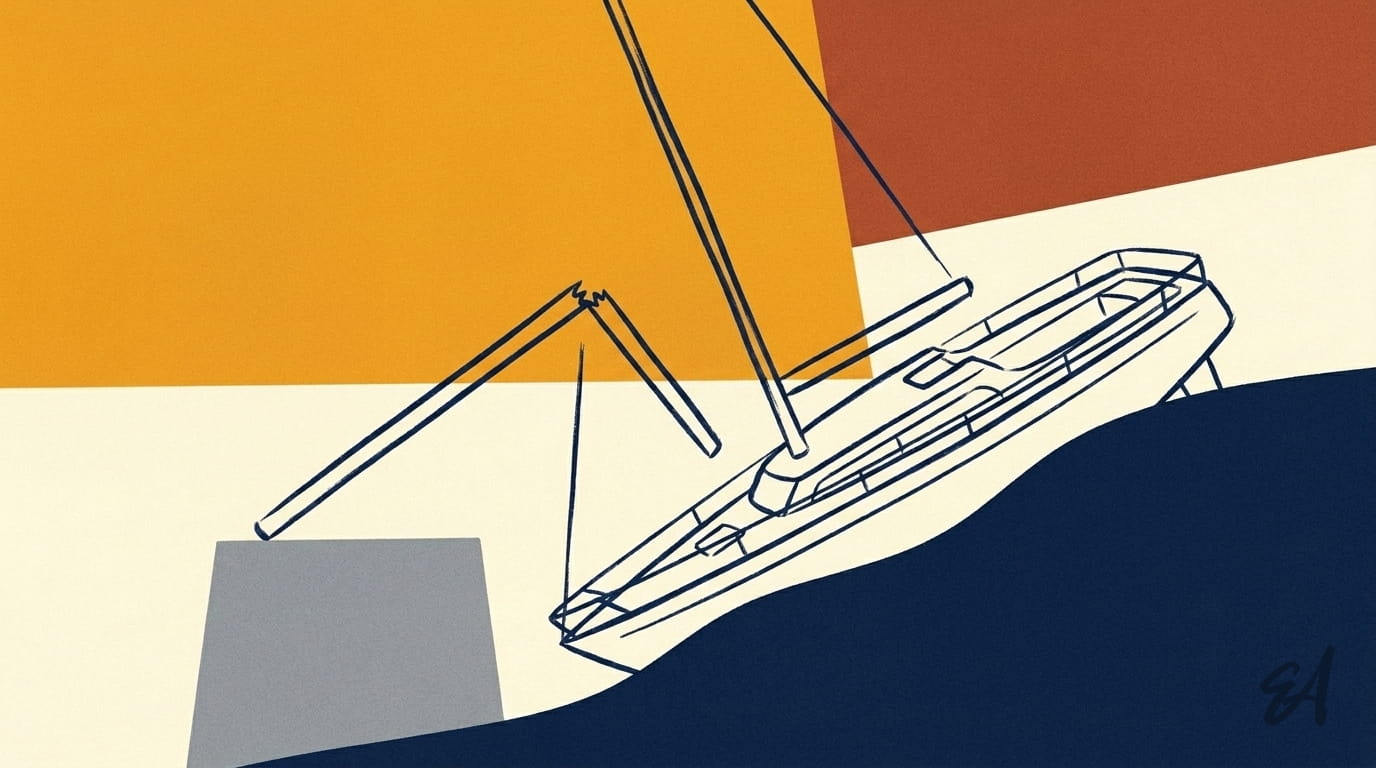
The investigation into the sinking of the yacht Bayesian, which occurred on August 19, 2024, off Porticello, has reached a crucial stage with the entry of the commander and several crew members into the register of suspects for shipwreck and multiple manslaughter. According to press reports, investigators are focusing on the management of onboard safety during the downburst that hit the vessel, analyzing whether there was an underestimation of meteorological risk and a violation of technical protocols. While other liability profiles related to workplace safety and state rescue efforts have been addressed separately, this insight focuses exclusively on the role of the commander as the head of the onboard hierarchy. Through the lens of maritime law, we will explore how jurisprudence qualifies the duty of protection toward passengers and crew, using a twin case to illustrate the mechanics of assessing omissive negligence.
In brief
The article examines the criminal liability of the commander in the Bayesian shipwreck, focusing on the position of guarantee and improper omissive negligence. It analyzes the regulatory framework of the Navigation Code and the Cassation's guidelines on the predictability of extreme weather events. Through a didactic twin case, the causal link between the violation of safety protocols (such as closing hatches) and the tragic event is illustrated, distinguishing between unforeseen fatality and technical negligence.
The facts
On August 19, 2024, at approximately 04:00 AM, the luxury yacht Bayesian sank off the port of Porticello during an extreme weather event qualified by experts as a downburst. According to reports from news outlets such as Ansa and Il Sole 24 Ore, the shipwreck caused the death of seven people, while fifteen were rescued. At the present stage of preliminary investigations, the Public Prosecutor's Office of Termini Imerese has entered the commander James Cutfield, the chief engineer, and a watchkeeping sailor into the register of suspects.
The prosecution hypothesis suggests a chain of human errors that allegedly rendered the vessel vulnerable, despite its being technically considered unsinkable. Under investigation are the failure to alert passengers in a timely manner, the possible opening of side hatches that may have facilitated a massive influx of water, and the position of the lifting keel. Investigators are thus examining the management of so-called induced vulnerability, verifying whether the crew ignored radar signals and weather alerts that required the preventive securing of the hull.
The relevant laws
The regulatory framework is based on several fundamental provisions of the Navigation Code and the Criminal Code:
- Article 295 of the Navigation Code establishes that the commander is the head of the expedition and exercises police and safety powers, establishing a primary and non-delegable responsibility for the lives of those on board.
- Article 1123 of the Navigation Code punishes negligent shipwreck with imprisonment for up to five years, a penalty that increases significantly if multiple deaths result from the act.
- Article 589 of the Criminal Code governs multiple manslaughter, applicable when death is caused by the violation of technical cautionary rules.
- Article 40, paragraph 2, of the Criminal Code introduces the equivalence clause, whereby failing to prevent an event that one has a legal obligation to avoid is equivalent to causing it, grounding liability for the commander's omissive conduct.
What the case law says
The case law of the Court of Cassation has consolidated the principle that the commander of a vessel holds an absolute position of guarantee. This role imposes the duty to foresee even critical meteorological scenarios whenever onboard instruments or bulletins signal their possibility. The courts have clarified that the exceptional nature of an atmospheric phenomenon, such as a gale or a downburst, does not automatically exclude negligence if the devastating effects were facilitated by failure to observe technical rules of prudence, such as closing portholes and watertight hatches.
According to the prevailing orientation, liability remains even in the event of errors by subordinates if the commander has not properly exercised his duty of direction and control. Furthermore, the Court of Cassation has specified that the causal link between the omission and the event exists whenever it can be established that compliance with cautionary rules would have, with high logical probability, prevented or delayed the shipwreck, allowing for the rescue of passengers. The criterion of conduct exigiibility is evaluated based on the average technical knowledge required of a professional in the sector under similar emergency conditions.
- Try edit.legal AI
Analysis drafted and verified with edit.legal
To verify the provisions cited in this article, we used edit.legal. Test our legal AI on official sources and apply it to your own matters.
What it teaches professionals
- Defense in the maritime field must focus on proving the technical unpredictability of the weather phenomenon relative to the available instruments.
- It is essential to distinguish between the commander's negligence and that of the shipowner for any hidden hull defects.
- The analysis of the so-called SMS (Safety Management System) is the key document to verify whether emergency procedures were adequate and known.
- The technical expert report on the causal link represents the decisive element to overcome the presumption of omissive negligence in the event of a shipwreck.
References: Articolo 295 Codice della NavigazioneArticolo 1123 Codice della NavigazioneArticolo 589 Codice PenaleArticolo 40 comma 2 Codice PenaleArticolo 274 Codice della Navigazione
Related cases

Frequently asked questions
What criminal risks does a ship commander face in the event of a shipwreck?
The commander faces conviction for negligent shipwreck and multiple manslaughter, with penalties that can exceed 10 years of imprisonment depending on the number of victims and the severity of the negligence.
Does an extreme weather event always exclude the commander's negligence?
No, negligence is excluded only if the event was absolutely unforeseeable and unavoidable; if radars or bulletins provided warnings, the commander is obliged to secure the ship preventively.
Is the shipowner civilly liable for damages caused by the commander?
Yes, the shipowner is liable for the acts of the commander and the crew by virtue of vicarious liability, without prejudice to the right of recourse against those responsible.
Verified legal research and drafting with edit.legal
Legal research and drafting with citations checked against official databases. edit.legal is free to try, no credit card.
Try edit.legal for free