The case, explained
Liability for Wildlife Damage and Constitutional Referral
6 min read · Updated August 2026 · Editorial oversight: Avv. Federico Papa
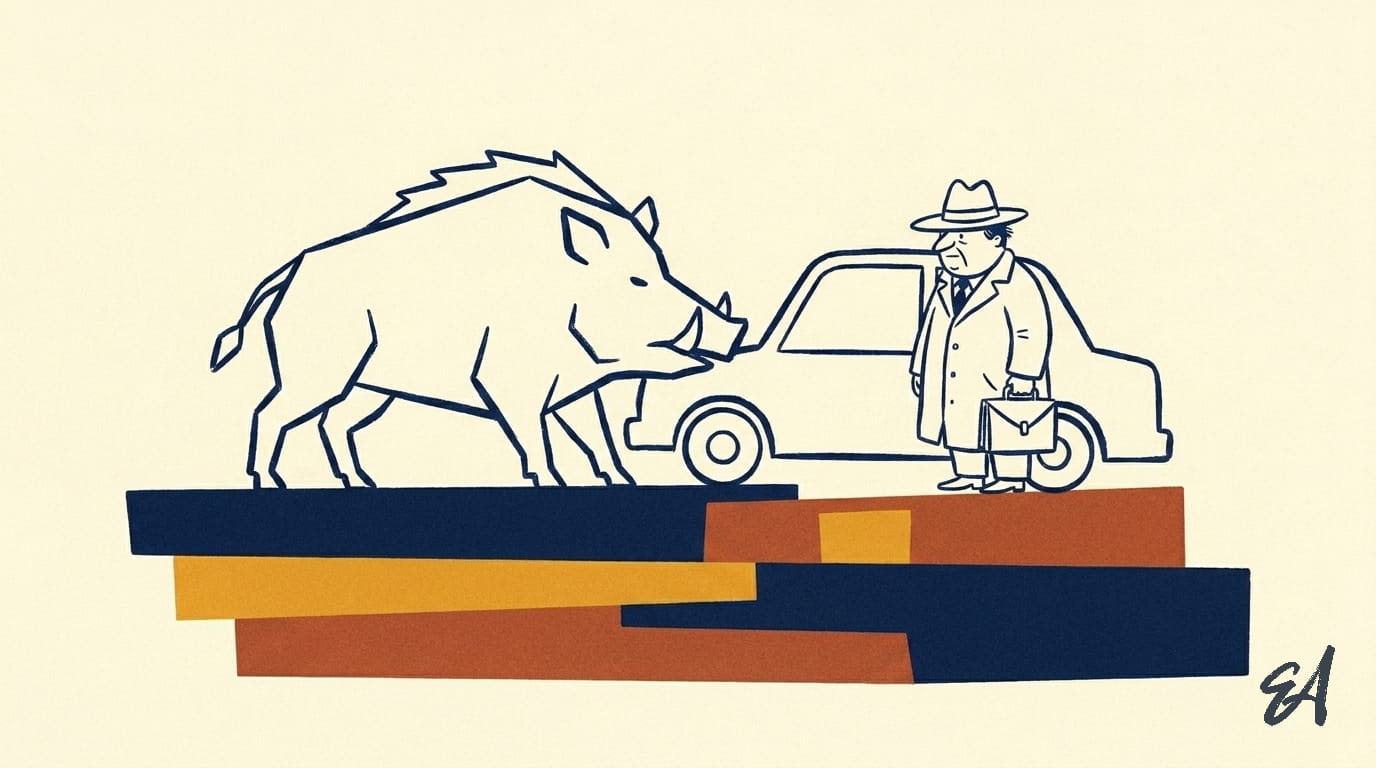
The issue of compensation for damage caused by wildlife has reached a decisive turning point with a new referral to the Constitutional Court. According to reports in the specialized press throughout 2024, the heart of the debate concerns the compatibility between regional laws, which often provide only partial indemnity, and constitutional principles of equality and property protection. This article traces the jurisprudential evolution that transformed the liability of public bodies from a fault-based system to a strict liability regime, culminating in the question of constitutionality now awaiting the Court's scrutiny. Through our twin case, we will see how this theoretical dispute translates concretely into the financial position of a driver involved in an accident with a wild ungulate.
In brief
The referral to the Constitutional Court challenges regional laws that limit compensation for wildlife damage to mere indemnities. Case law has already established the applicability of strict liability under Art. 2052 of the Civil Code to the Regions. The analysis examines the shift from a fault-based regime to one of custody, exploring the protections available to drivers and the evidentiary burden required to overcome administrative limitations.
The facts
The matter arises from a series of disputes brought by drivers following violent collisions with wild boars and deer on provincial and regional roads. According to reports published in «Altalex» and «Il Sole 24 Ore», the Tribunal of L'Aquila raised ex officio the question of constitutional legitimacy concerning a regional provision that made compensation contingent upon limited fund availability, thereby converting the right to full reparation into a mere symbolic indemnity. The proceedings, currently at the referral stage before the Constitutional Court following the first instance, pit damaged citizens against regional administrations. The latter argue that wildlife, as un-fenced non-disposable State property, cannot be subject to effective custody, thus requesting the application of a less burdensome liability regime than that governing domestic animals.
Relevant legal framework
The core provision is Art. 2052 of the Civil Code, governing damage caused by animals and establishing strict liability for the owner or user, save for proof of a fortuitous event. This operates alongside Art. 2043 of the Civil Code, the general fault-based tort provision, which historically represented the sole path pursued by injured parties prior to the recent interpretative turning point. At the constitutional level, Art. 3 of the Constitution (principle of equality) is central to avoiding discriminatory treatment between victims of wild and domestic animal damage, alongside Art. 24 of the Constitution, guaranteeing the right to judicial protection of one's legal positions. Finally, national legislation on wildlife protection classifies wild animals as non-disposable State heritage, entrusting their management to the Regions.
What the case law says
Case law from the Supreme Court of Cassation has undergone a radical turnaround in recent years. While it was previously held that wild animals could not be subject to custody, thereby excluding the applicability of Art. 2052 of the Civil Code, current authority clarifies that the Region is the liable entity as the holder of administrative management and control powers. The driver must therefore only prove the causal nexus between the wild animal and the accident, as well as compliance with traffic rules. The Supreme Court further specified that any delegation of functions to Provinces does not transfer legal standing to be sued, which remains with the Region. Conversely, the debate remains open regarding the validity of regional laws capping damages, an issue upon which the Constitutional Court must now rule to ensure uniform application across national territory.
- Try edit.legal AI
Analysis drafted and verified with edit.legal
To verify the provisions cited in this article, we used edit.legal. Test our legal AI on official sources and apply it to your own matters.
Key takeaways for legal practitioners
- Evidentiary promptness: it is essential to immediately secure evidence of the causal nexus (police reports, biological traces, photographs) prior to any alteration of the accident site.
- Procedural strategy: practitioners should name the Region as the sole party with standing to be sued, joining Provinces or Park Authorities only on a subordinate basis.
- Constitutional monitoring: counsel should consider requesting a stay of proceedings or avoiding unfavorable settlements pending the Constitutional Court's decision on regional indemnity caps.
References: Art. 2052 c.c.Art. 2043 c.c.Art. 3 Cost.Art. 24 Cost.
Related cases

Frequently asked questions
What should I do immediately after an impact with a wild animal?
It is necessary to immediately call law enforcement to draft an official accident report, take detailed photographs of the vehicle and surroundings, and preserve any biological traces confirming the involvement of the wild animal.
Can I claim damages if there was no 'wild animals' warning sign?
Yes. Although missing warning signs may support administrative negligence, application of strict liability under Art. 2052 of the Civil Code operates independently of fault, releasing the public authority from liability only upon proof of a fortuitous event.
How much time do I have to take action against the Region?
The standard statute of limitations for damages arising from motor vehicle accidents is two years under Art. 2947 of the Civil Code; however, when claiming strict liability for custody under Art. 2052 of the Civil Code, legal doctrine and case law often apply the general five-year limitation period.
Verified legal research and drafting with edit.legal
Legal research and drafting with citations checked against official databases. edit.legal is free to try, no credit card.
Try edit.legal for free